
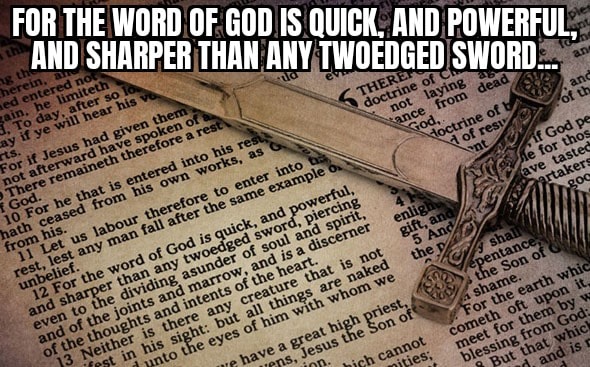
Proof texting is the method by which a person appeals to a biblical text to prove or justify a theological position without regard for the context of the passage they are citing.
A common from of proof-texting is eisegesis. Eisegesis is interpreting a passage in ways that introduce one’s own presuppositions, agendas or biases. It is commonly referred to as “reading into the text”. Eisegetical proof-texting is often done to justify or confirm a position already held by the proof-texter.
Eisegesis is best understood when contrasted with a more proper approach to understanding scripture: exegesis. Exegesis is drawing out a text’s meaning in accordance with the author’s context and discoverable meaning. Eisegesis is when a reader imposes their interpretation of the text. Thus exegesis tends to be objective and data-driven; while eisegesis is highly subjective.
Here are some common examples that are relevant to the express purpose of this website, and thus will likely come up from time to time:
Eisegesis/Proof-texting: “Jesus wants us to use force and violence for self-defense — He told His disciples to buy swords, and to sell their coats if necessary!”
Exegesis: Jesus didn’t command his disciples to sell their cloaks and buy swords for self-defense, but to fulfill prophecy that Jesus would be found among transgressors of the law (it was illegal for Jews to be armed in Roman-occupied Jerusalem). When Jesus discovered they had two already, He told them that’s enough. Two is not enough to defend a dozen men. It was enough to fulfill the prophecy, however. (Luke 22: 36-38) It should be noted that, not long after this incident, Peter used one of the two swords for self-defense, and was rebuked. He was then admonished “those who take the sword, die by the sword”.
Eisegesis/Proof-texting: “Jesus is okay with violence — Even He said He didn’t come to bring peace, but a sword!”
Exegesis: Jesus did not come to bring peace, but a metaphorical sword. The peace He speaks of is harmony in groups like families and friends. The sword of the Word, and of the Spirit which testifies of the Truth of that Word, will be believed and accepted by some, and rejected by others. Often those who accept and reject will be close friends and family with one another, and the acceptance or rejection of the Gospel will become a matter of contention and strife within the group. Therefore, this sword will cut (what swords do) these groups asunder metaphorically — children will separate from their parents, etc., when some follow Jesus, and others reject Him. Jesus is in no way advocating using force or violence in any way or under and circumstance. (Matthew 10: 32-39)
Eisegesis: “The Book of Revelation says that Jesus will come with a sword in His mouth in the last days — so He must be okay with some violence!”
Exegesis: The Word of God is “sharper than any sword” (Heb 4:12) and in the Last Days, Jesus will bring the WORD in His mouth, and the Spirit will testify of the truth of His words, which Word and Spirit (both compared to a sword in different places in the New Testament) will defeat His enemies by converting them so they are no longer enemies at all. PLEASE stop pretending you believe Jesus will come with a literal sword popping out of His literal mouth so you can justify your bloodthirst against people who believe differently than you at some future apocalyptic battle. A sword in His mouth, in the most symbolically laden book in the entire New Testament, should not be taken literally.
People who already believe that violence is necessary, twist Jesus’ words to make violence something it isn’t. Violence is not righteous. It can, under certain, specific circumstances, be justified, but not righteous (D&C 98:23-32). And twisting and proof-texting scripture to make any and all violence in self-defense a Jesus-endorsed, moral good, is not at all justified.